
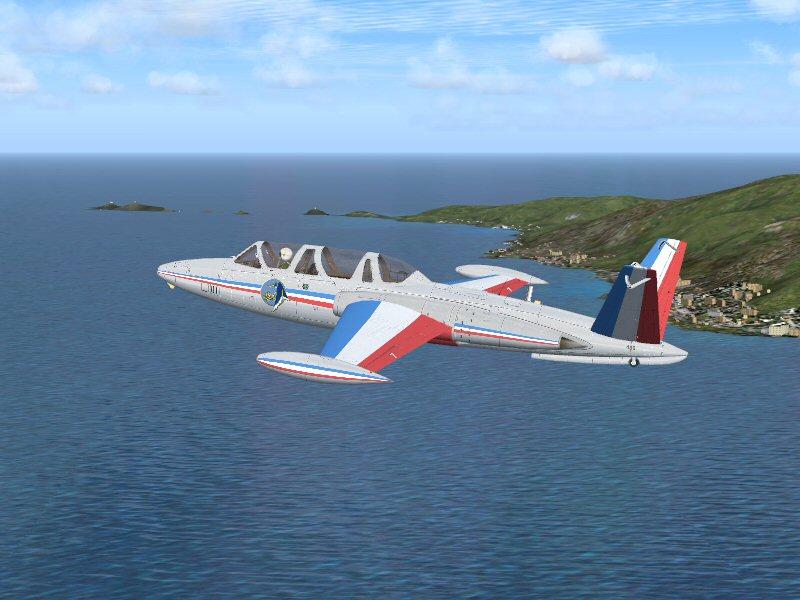
Fouga Magister CM170 v1.1 FSX
Three presentations, including a rear-seat flying variant. GPS, DME, an autopilot and detailed documentation accompany the model.
Images and screenshots
4 photosFull screen
On this page
Overview
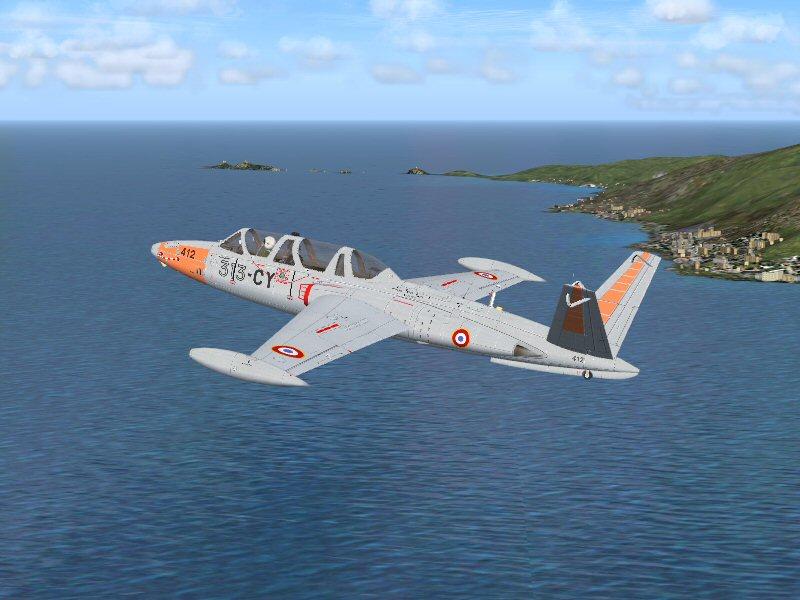
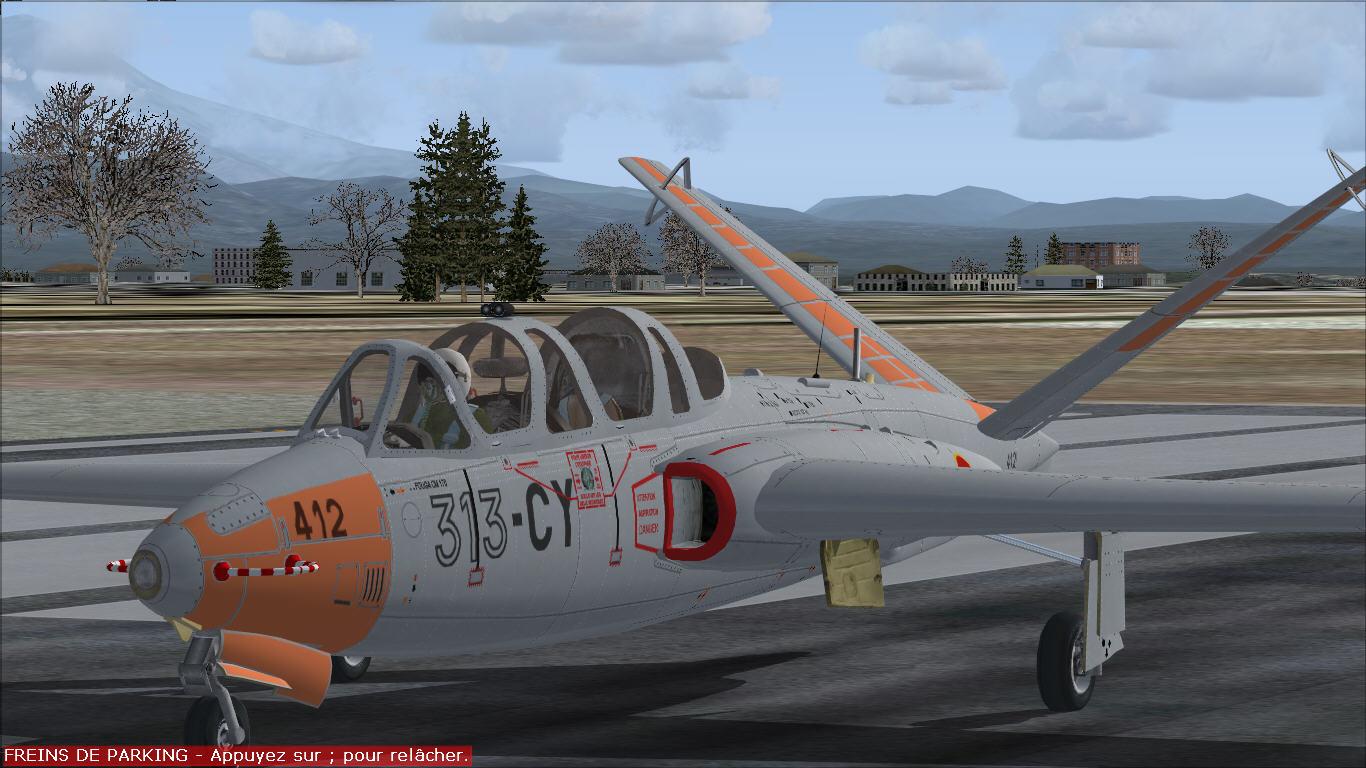
Restauravia’s Fouga Magister CM170 v1.1 for FSX offers three presentations: the lower serial-number aircraft, represented by No. 62; the higher numbers, such as No. 412, with distinctive whisker-shaped VOR antennas; and the Patrouille de France’s 1966 scheme. The higher-number presentation includes a dual-control (DC) model that can be flown from the rear seat.
Model-specific features
Every aircraft in the pack uses Marboré VI engines and the corresponding performance. This is a deliberate simplification: real aircraft below serial number 436 had the less powerful Marboré II engines.
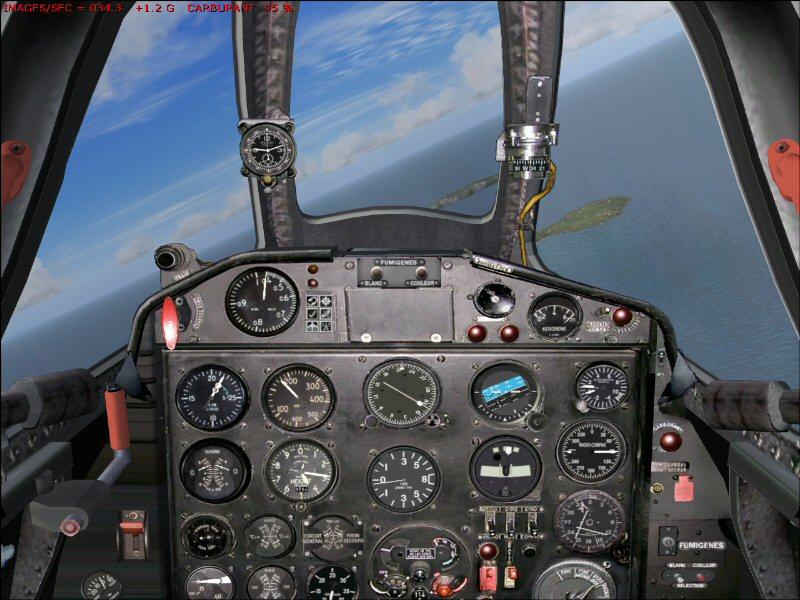
For use in the simulator, the authors added a steerable nosewheel, GPS, DME, an autopilot and extra flap, landing-gear and airbrake lights within the pilot’s field of view. The real aircraft used its brakes for ground steering. Full English documentation is included.
Figures from the documentation
The Marboré VI version is listed with a 2,900 kg maximum take-off mass, two engines rated at 480 daN at ground level, a maximum engine speed of 21,500 rpm and flight limits of 400 kt and Mach 0.82. Wingspan is 12.15 m, length 10.06 m and height 2.80 m; the butterfly tail has an angle of 110°.
Designed by Robert Castello and Pierre Mauboussin, with Turboméca engines, the Magister first flew on 23 July 1952. The two-seat twinjet became a military trainer and served with the Patrouille de France from 1964 to 1980.
Modelling and integration: André Chancel; 2D panels and gauges: Jean-Pierre Langer; flight dynamics: Jean-Pierre Bourgeois; ground handling: Benoit Dubé; textures: Marc Hardouin. Technical adviser: Henri Guyot, a former Magister instructor. Restauravia.
Licences and credits
- Author
- Andre Chancel (Restauravia.com)

Comments
Flight experiences, tips and questions from Rikoooo members.
Loading discussions…